“The 12-Week Year” by Brian P. Moran and Michael Lennington (personal notes)
Here are my notes on Brian P. Moran and Michael Lennington’s The 12-Week Year.
Two Weeks times 6
- Compress time. By making of twelve weeks a year, you get to live multiple years in a year. (Compress space: The Life-Changing Magic of Tidying up)
- Deadlines for giant steps (× Tiny Experiments)
- People live under the illusion that time is infinite.
- Not a year divided in quarters (× OKR); rather, the quarter is the year.
- The 12-week year is the foundation of your operational system. (× Tiny Experiments)
- Deadlines for giant steps (× Tiny Experiments)
Vision
- Start with a vision. (× Psycho-Cybernetics) The vision is the foundation. Write it down. It really helps clarify (!)
- Write down your long-term vision for each life area (spiritual, relationships, family, community, work, personal, physical). Then write down your 3-year vision for the elements that resonated the most with you. Keep the document close to you, refer back to it regularly — especially when the going gets tough. Align constantly with why you’re doing the things.
- “What do you want spiritually?”
- Regularly envision the life you desire, the vision you emotionally connect to.
- “Impossible — possible — probable — given”: making visions happen.
- “Behind every impossible achievement is a dreamer of impossible dreams. (Robert K. Greenleaf)
- “If you think you can or think you can’t, you’re right.” (Henry Ford)
- Share your vision with others. (× Pavlina’s Broadcast Your Desires)
- Write down your long-term vision for each life area (spiritual, relationships, family, community, work, personal, physical). Then write down your 3-year vision for the elements that resonated the most with you. Keep the document close to you, refer back to it regularly — especially when the going gets tough. Align constantly with why you’re doing the things.
- “Our last free act — after which no further free acts are possible — is to deny that we are free.” (Peter Koestenbaum)
Planning
- Planning is one of the most productive things you can do. Avoid busywork.
- “It is not enough to be busy; so are the ants. The question is: What are we busy about?” (Thoreau)
- Focus on a few areas of your life at a time. A few areas of focus (× Essentialism) per year — what is the highest priority.
- Sports periodization — focussing on a improving a specific skill for four weeks.
- “Life balance is not about equal time in each area; life balance is more about intentional imbalance.”
- Take some time off in between years.
- “The great people, the giants of history whether in politics, culture, art, science, religion, or any endeavor you can think of, had no more time in each day than you do.”
Execution
- Execution is the market differentiator.
- Results are provided by actions; actions are guided by thinking. Your thinking determines your results.
- “We are what we repeatedly do. Excellence then is not an act, but a habit.” (× our actions form a shape over time (At the Existentialist Café))
- Keystone action — sometimes focussing on a keystone action is enough, rather than a fully-fleshed action plan.
- Strive for excellence, not perfection. Completing 85% of your top tactics weekly gets you there.
- Time-blocking: Strategic blocks (zone-work-time), buffer blocks (bundling low-value, unplanned activities and chores and tackling them in one go), breakout block (deliberate free time / daydreaming time)
- Fear (of the new); aversion to the new: the amygdala makes us shy away from novelty, risk and uncertainty. For change to happen, we need to override it.
- Emotional cycle of change
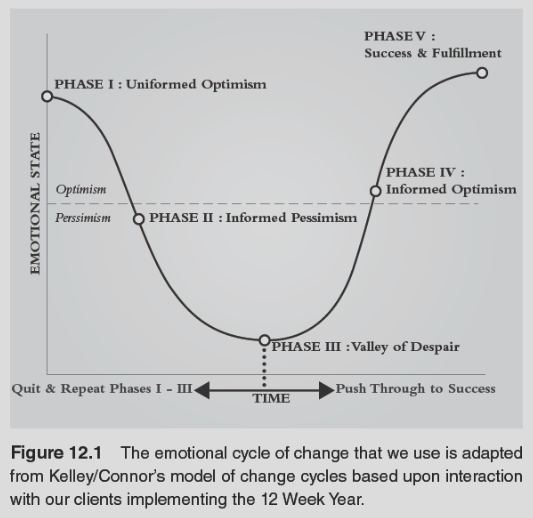
- Focus on your compelling vision when at the dip.
- Emotional cycle of change
- “Without a compelling reason, people will choose comfortable actions over uncomfortable ones. People avoid short-term pain by default (× Naval). Have a vision for the future that you want more than your short-term comfort.
- Make progress based on your vision every day. “Did this day move me forward?”
- Productive tension — uncomfortable feeling when you’re not doing the things you should be doing. You can respond either by flight (drop the system) or fight (push through).
- Reactivity vs intentionality. Not letting yourself be swayed around by the vagaries of the day.
- “If we did the things we are capable of doing, we would literally astound ourselves.” (Thomas Edison)
- “Tell me, what is it you plan to do with your one wild and precious life?” (Mary Oliver)
- If you want to know what your future holds, look to your actions; they are the best predictor of your future. Today is forever. How you spend your days is how you spend your life.
- Small differences daily make for big differences down the line. The extra mile daily.
- “The difference between greatness and mediocrity on a daily and weekly basis is slim, yet the difference in results down the road is tremendous.”
- “The fall of dropping water wears away the stone.” (Lucretius)
- Small differences daily make for big differences down the line. The extra mile daily.
Measuring
- Track and record your progress each week — good for motivation.
- Measurement builds self-esteem and confidence because it documents progress and achievement.
- Lead & lag indicators. Lead: measures of your execution; lag: measures of the results (dependent on the efficacy of the strategy).
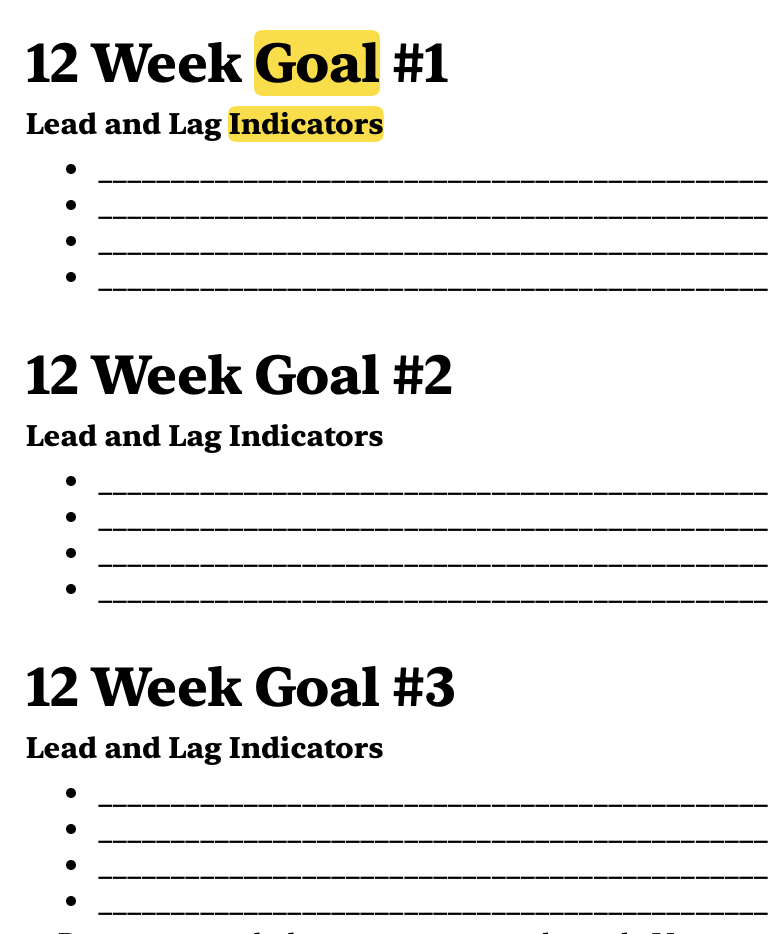
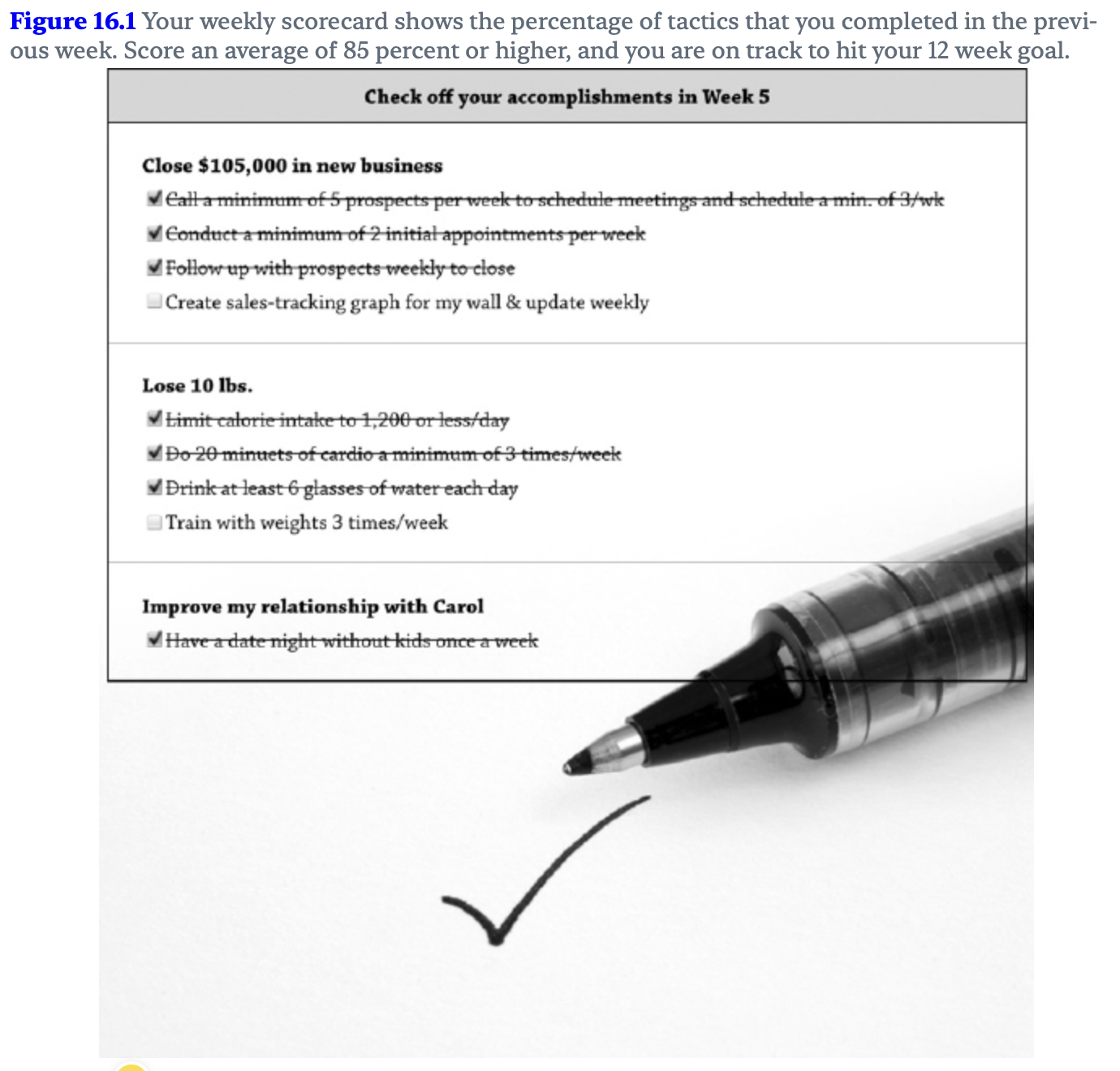
- Problem of strategy vs execution. Only by following through on a strategy (× Tiny Experiments) can you gather clear data about the strategy. All failure is information. (× failure (Improvise))
Commitment
- Keys to a successful commitment:
- Strong desire (emotionally compelling vision)
- Keystone actions — identified strategies/tactics
- Costs/sacrifices accounted for — ahead of time. Knowing what you’re signing up for.
- Act on commitments, not feelings.
- Interested vs committed.
- “When you’re interested in doing something, you do it only when circumstances permit, but when you’re committed to something, you accept no excuses, only results.”
- When committed, the question of “if” goes away and the only question you ask is “how”.
- 12-week years make commitments easier (because time-bound) (× Tiny Experiments) — a practice of commitments.
Weekly review
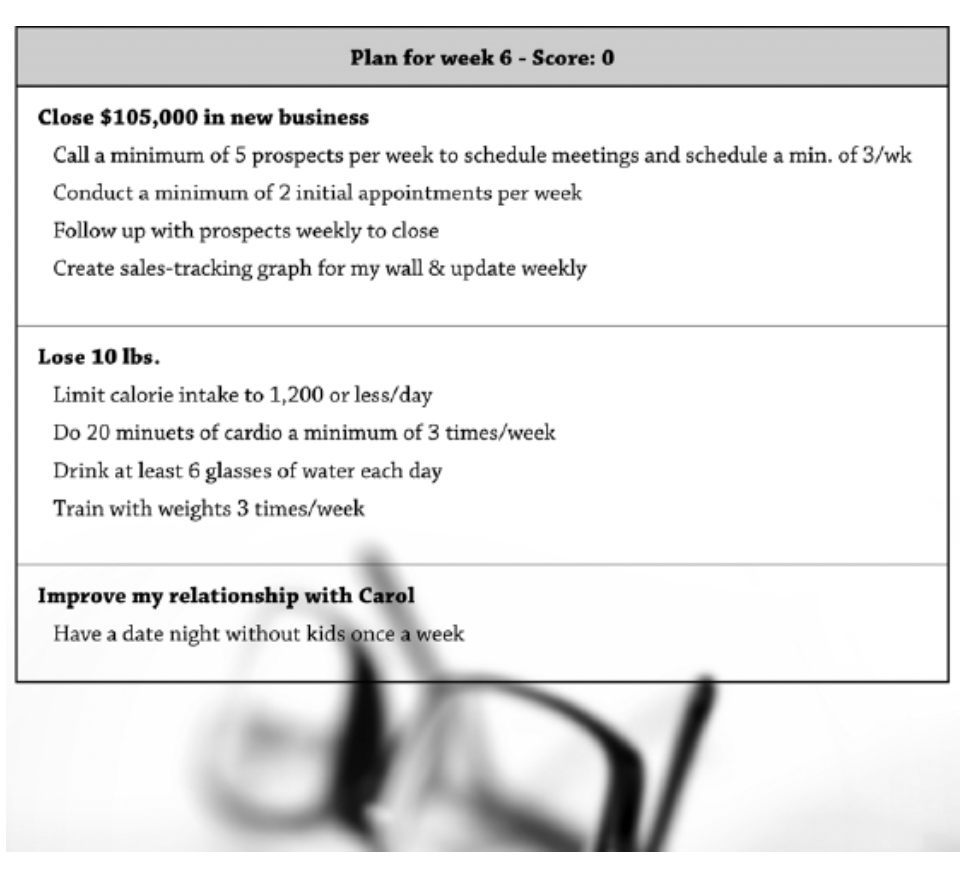
- Weekly review & prep. Once a week, review how your week went and prepare your actions (“tactics”) for the next week. (× “If you don’t know what the most important thing to do is, then it is to figure it out.”, Essentialism)
- Reconnect with vision
- Assess weekly lead & lag indicators; progress towards 12-week goals
- Adjust as needed
- Plan next week’s tactics
- “Don’t start a week without a weekly plan.”
Co-coaching
- Co-coaching: have a check-in group (WAM) — weekly 15-min meeting to check in on people’s progress, achievements, struggles. Co-support/co-coaching.
- Suggested format:
- Individual Report Out:
- Results for 12-week year so far
- Weekly execution score
- Intentions for coming week
- Feedback and suggestions from group
- Group discussion on successful techniques & co-coaching
- Encouragement
- Individual Report Out:
- Suggested format:
Accountability
- “Accountability is an inevitable outgrowth of freedom. It cannot be imposed, demanded or coerced.
Other
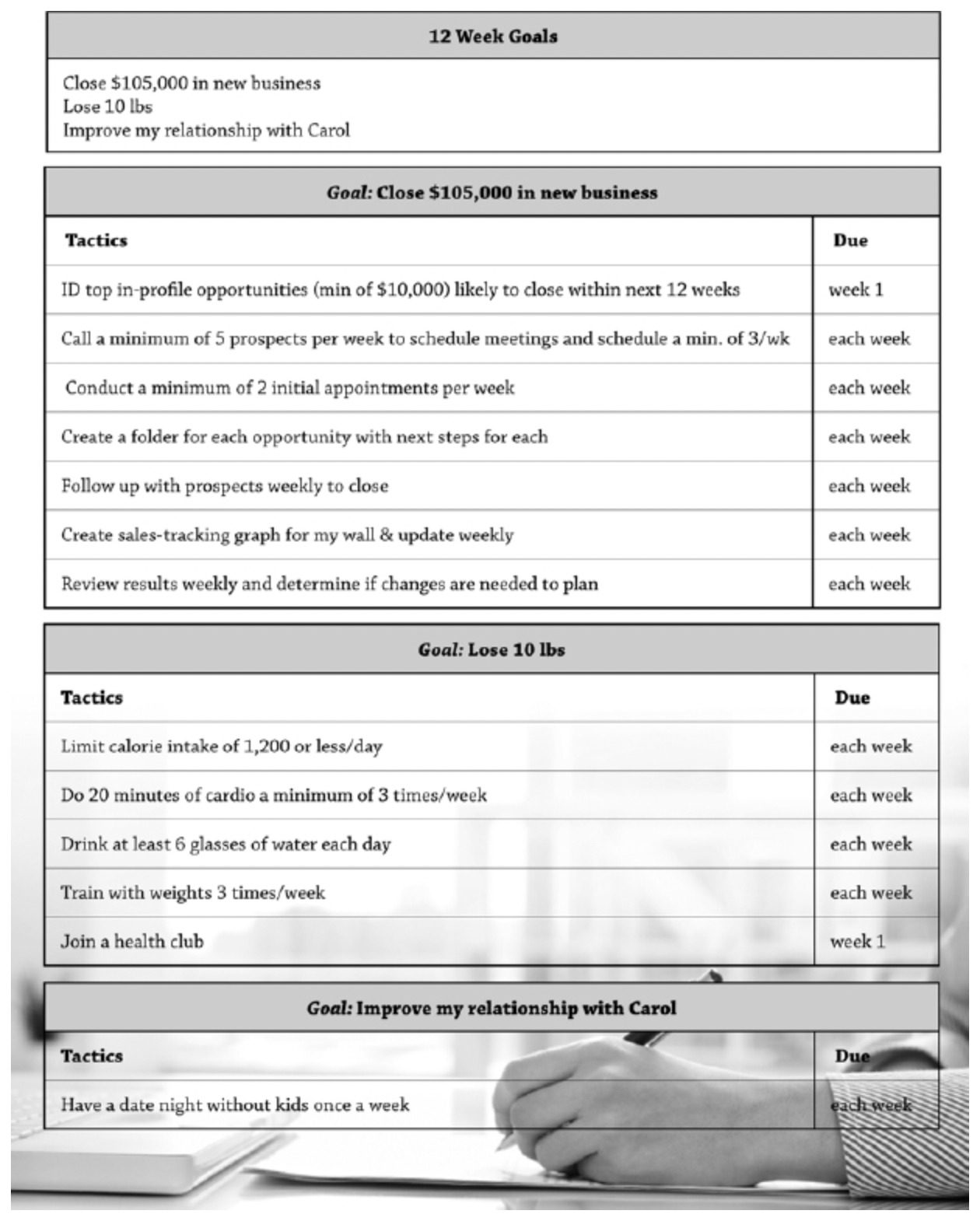
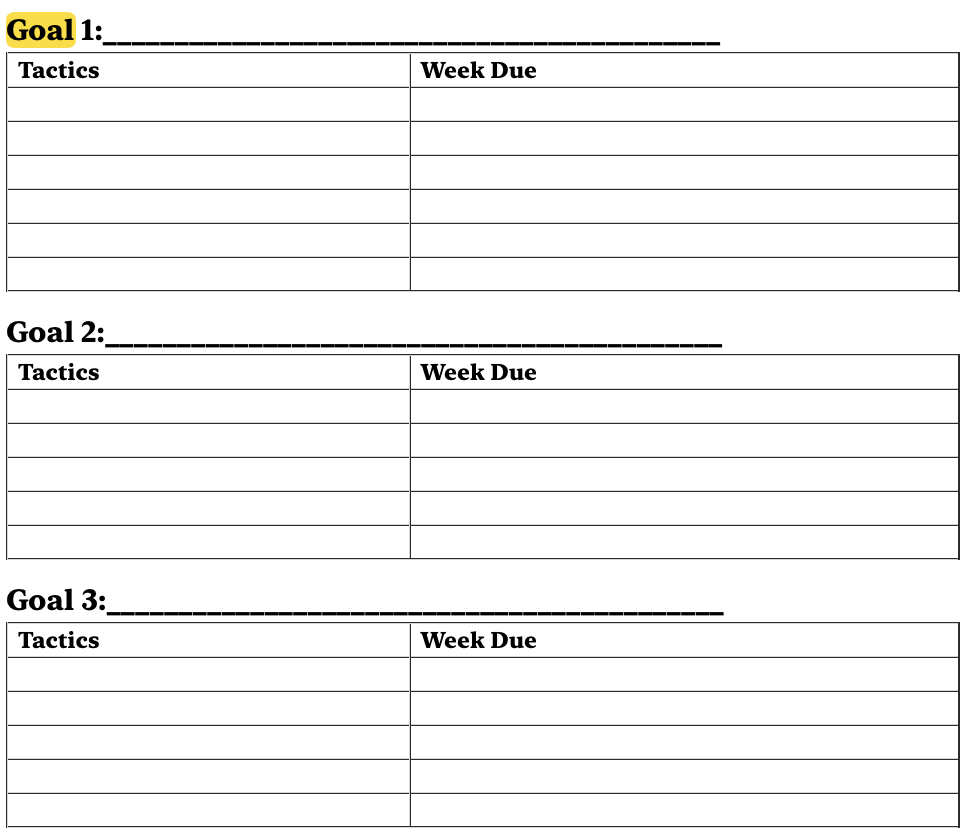
- Sample 12-week plan