“The Culture Map” by Erin Meyer (personal notes)
Here are my notes on Erin Meyer’s The Culture Map.
—
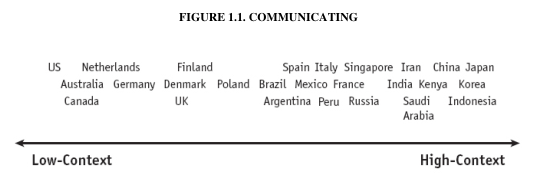
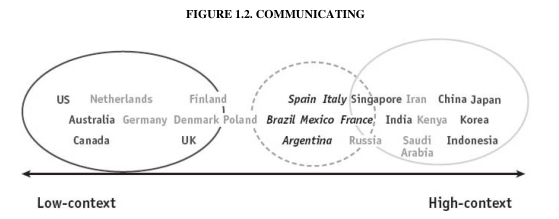
- Communication style: explicit/implicit (direct/indirect).
- Implicit cultures (Asia, to a lesser extent France (Jean de la Fontaine, rewriting letters politely, etc.))
- Implicit cultures emerge from a long shared history, often relationship-based.
- (× Kitchen Confidential, Shop Class as Soulcraft: time spent together making for inside jokes etc.; subcultures (TPOT))
- Long-term couples know each other well, pick up on subtle cues; high context cultures (implicit) as requiring emotional intelligence.
- Insular history: e.g. Japan (no overseas contact for a long time)
- “No” is said between the lines. (Asia — especially to clients/bosses)
- People refuse out of politeness, have to be asked twice again to tell the real answer.
- Soft refusals to protect the other’s face (as if masks weren’t enough).
- Take “soft no’s” (changing subject, vague postponements) seriously in indirect cultures.
- Implicit cultures have fewer words (more context-dependent meanings); explicit cultures have more words (precise meanings). French (implicit) vs English (explicit).
- Implicit cultures are the least intercompatible. The biggest misunderstandings happen between two different implicit cultures — as they both assume different things.
- Implicit cultures emerge from a long shared history, often relationship-based.
- Explicit cultures (all Anglo-Saxon countries, USA first and to a lesser extent UK (British humour)).
- Explicit cultures emerge as a need from a recent, multi-cultural history. (USA)
- Explicit cultures are often task-based.
- Explicit cultures favour showing interest explicitly in courting (NL, DE, USA).
- Implicit cultures (Asia, to a lesser extent France (Jean de la Fontaine, rewriting letters politely, etc.))
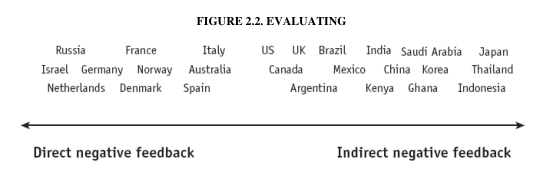
- Negative feedback (direct/indirect negative feedback)
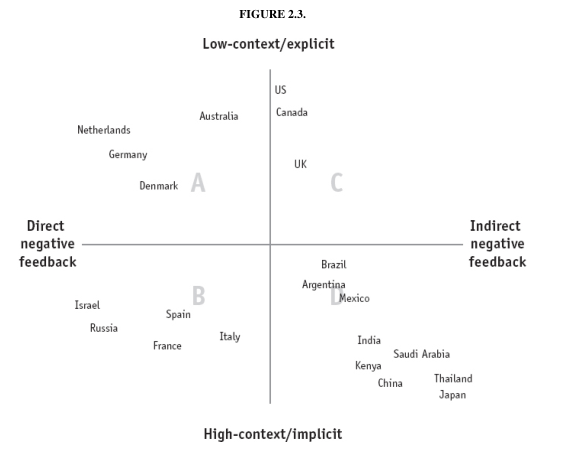
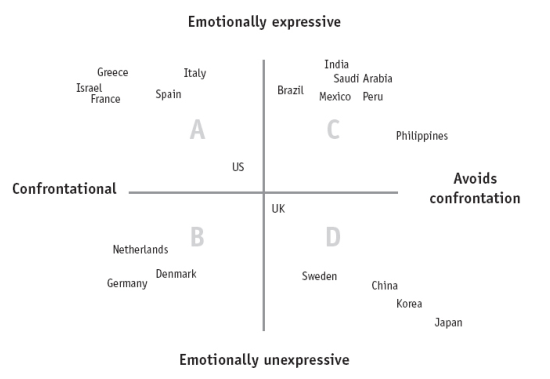
- No link between explicit/implicit & direct/indirect negative feedback.
- (Quadrant A) NL, DE, DK, AU: Explicit & direct.
- (Quadrant B) France, Russia, Spain, Italy, Israel: Implicit & direct
- (Quadrant C) USA (to a lesser extent GB, CA): Explicit & indirect
- Three positives for one negative.
- Negative feedback in positive language.
- Soften the negative feedback you give. Use qualifiers.
- (Quadrant D) Asia (particularly JP, TH, ID): Implicit & very indirect (— though indirectness can be overruled by hierarchy.)
- Deliver the negative feedback slowly over time, “so it gradually sinks in”.
- Use food & drink to blur an unpleasant message.
- The Chinese are relatively more direct than the Japanese.
- Indirectness can be overruled by hierarchy (Asia, Russia): indirect towards the boss but direct towards subordinates.
- Your culture determines whether you can hear the negative feedback given to you. (× emotional intelligence; reading the room, Japanese “reading the air”, KY/kuuki yomenai, “someone who cannot read the air”, who doesn’t pick up on social cues)
- No link between explicit/implicit & direct/indirect negative feedback.
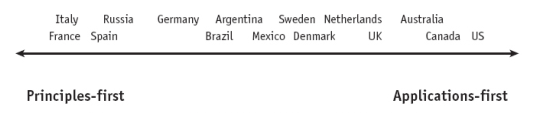
- Persuasion (principles/practical ; theory/practice)
- Principles vs practice
- Principles: (DE, FR)
- Start with philosophy, principles, the big picture. Start with the abstract.
- Management: explain why.
- (deductive)
- Practical: (USA)
- Get to the point quickly; use case studies; expected benefits/results; glitter.
- Management: just give orders.
- Start with the concrete — real-world observations, extrapolate to conclusions, recommendations.
- (inductive - × Psychedelics Revealing, × theories looking for applications and v/v; experience calling for understanding)
- Shows in:
- Theoretical vs practical schooling
- Common Law (USA/UK), practical first (setting a precedent) vs civil law (EU), principles-first.
- Principles: (DE, FR)
- Holistic vs specific
- Asian cultures & religions tend to be more holistic (reflexology, feng shui, etc.)
- Micro-to-macro (West), vs macro-to-micro (JP, CN)
- Profile picture as a close-up face shot (West) vs whole-body-in-context shot (Japan).
- In China:
- Addresses: province, city, district, block, gate number
- Names: Surname first
- Date: Year before month and date
- Management: explain the broader context / bigger picture in holistic cultures. (What colleagues are working on, how it all fits together.)
- Principles vs practice
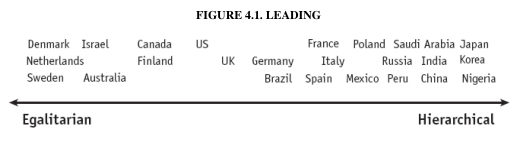
- Hierarchy (hierarchical/egalitarian)
- Historically, cultures influenced by the Romans (hierarchical, togas) vs Vikings (egalitarian) Spain & Italy vs Scandinavia.
- Historically, Protestant cultures (egalitarian) vs Catholic cultures (hierarchical). Talking to God directly, not though a priest.
- Hierarchical cultures:
- Shake hands first with the boss.
- In (online) communication, do not bypass the boss to talk to lower colleagues.
- Address informally everyone in descending rank.
- Invite subordinates to speak up (else they won’t)
- Shake hands first with the boss.
- In East Asia, use hybrid name/titles as a good compromise — “Mr. Mike”.
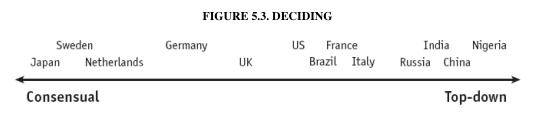
- Decision process (top-down/consensual)
- Hierarchy and decision style can be at odds.
- Germany and Japan are hierarchical but consensus-based.
- Top-down decisions are more flexible; consensual decisions are more definitive and can be implemented fast, as everyone is onboard.
- Nemawashi (JP): getting informal buy-in (consensus) before officially announcing the decision. Do it as a Westerner as well. (× “Being at the gemba” with frontline workers)
- Ringi (JP): low-level managers reaching a consensus among themselves before bringing the issue to the higher-level manager.
- Hierarchy and decision style can be at odds.
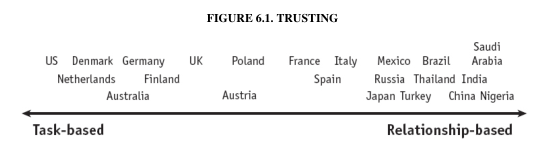
- Trusting (task-based/relationship-based)
- Historically, cultures with no strong legal framework became relationship-based.
- (But also: in-group cultures & knowing everyone, Debt)
- Cognitive trust vs affective trust: action-based trust vs emotional-based trust. Cognitive vs personal trust. “Business is business” vs “business is personal.”
- Westerners (US) separate the person from the business; CN/BR does not.
- Task-based
- Relationship-based (BRIC: BR, RU, IN, CN)
- Nomunication (JP): drinks with coworkers & managers. (× Trying Not to Try) If drinks are not for you, then karaoke, or spa.
- Share more meals, get to know them personally. Show your non-professional self.
- Cold calls are disfavoured. Ask a common friend to introduce you. (× The Mom Test — the goal of cold approaches is to stop having them.)
- Fire a salesperson and their clients will leave.
- “Trust is like insurance — it’s an investment you need to make up front, before the need arises”
- Peach vs coconut. Hard shell but soft inside (RU); soft outside (friendly) but quickly hitting the hard kernel (BR).
- Historically, cultures with no strong legal framework became relationship-based.
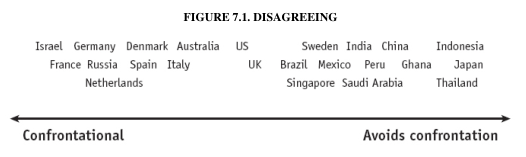
- Disagreement (confrontational/avoidant)
- Historically:
- Avoidant cultures, from needing to preserve unity (USA — melting-pot of cultures)
- “Harmony should be valued and quarrels should be avoided” — Japanese constitution.
- “Face” (as line/role, persona — e.g. acting out “a professor specialized in cross-cultural management”) (× To The Actor)
- Don’t put JP people on the spot — give them time to prepare.
- Historically:
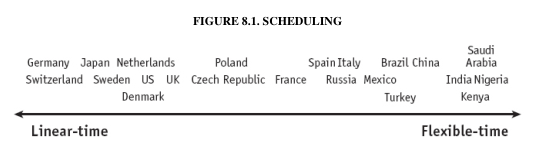
- Time (linear/flexible)
- Historically based on how predictable or unpredictable life is in a country.
- Relationship-based cultures tend to be flexible-time (giving spontaneous time to the relationships.)
- Brazilian culture: “Impolite to arrive on time — it will stress the host scrambling to finish preparations”
- Chinese are punctual but flexible — Japanese are more organized and linear.
- Countries’ positions on the scale are relative to your own culture — not absolute. An implicit culture can still be explicit compared to yours. (× “most people need it, but not you” (Psycho-Cybernetics))
- Countries’ positions on the scales correspond to the middle of their bell curve.
- Education tends to exaggerate the cultural tendency.
- One can travel the world without learning about the other cultures. Challenge accepted.
- Work in hospitality with a multicultural clientele to learn first-hand from the different cultures and adapt your behaviour accordingly (cf A).
- Meta-discuss communication & cultural styles.
- Making explicit and clarifying always helps. (× directness (relationships) (Pavlina, etc.)) (× communication, Sex Talks, Come As You Are, butter, etc.) — especially when you’re coming from different cultures. Doing the dance of implicitness only works if you come from the same culture.
- Working in multi-cultural teams:
- Explain the cultural differences and how to reconcile them
- Enforce explicit communication.
- e.g. 1-minute “How I Work” document (× Parity) — to bridge across cultures (though it makes everyone have to adapt to each person.)
- Let the people in your team culturally best at something, to do it when the
new yorktimes call. (e.g. providing indirect negative feedback; being flexible, etc.)
- Self-deprecate your culture and flatter the other’s — when confronted with a cultural issue or making a fax piss. Laugh about your own culture. (× Sex Talks: laugh about it)
- Meta: Elements of Book Writing (× Tiny Experiments)
- Start the book with a story
- Monetize by charging for the full information (Culture Map Online Tool) (not revealing the whole knowledge but just providing a preview in the book — dark arts). Charging for access to a database (to people who can afford it.)